

Blog
Starlink Satellite Kit Wholesale Distribution for Fleets


Wholesale Starlink kits can serve three main needs: fixed home setups, mobile connectivity for vans, RVs, and boats, and business connectivity for offices. A Starlink satellite kit wholesale distributor can help commercial buyers source hardware in bulk, while Mini units offer a compact option for fleet deployments. The right product mix depends on where each unit will be used and how the fleet operates.
Buying in volume can make procurement easier to coordinate, but choosing a kit based only on size or its headline use case can leave practical needs overlooked. Fleet buyers also need to plan installation, account for vehicle and site requirements, and confirm Starlink service availability at each operating location.
This guide explains which kit classes suit commercial resale, how bulk Mini orders may fit fleet needs, and what affects wholesale procurement and lead times. It also covers the factors to consider when planning an order, so you can compare options and make informed purchasing decisions.
Key Takeaways
- Match Mini kits to fleet use cases by considering where units will operate and what installation setup each vehicle requires.
- Compare standard, mobile, and business kit classes against resale customers’ needs before planning a wholesale assortment.
- Build a procurement plan around order quantities, destination, and shipping coordination, which shape the purchasing timeline.
- For broader wholesale purchasing, explore One Store Solution’s OCB ACCESORIES and other listed merchandise alongside your business inventory needs.
Bulk Starlink Mini sales for fleets
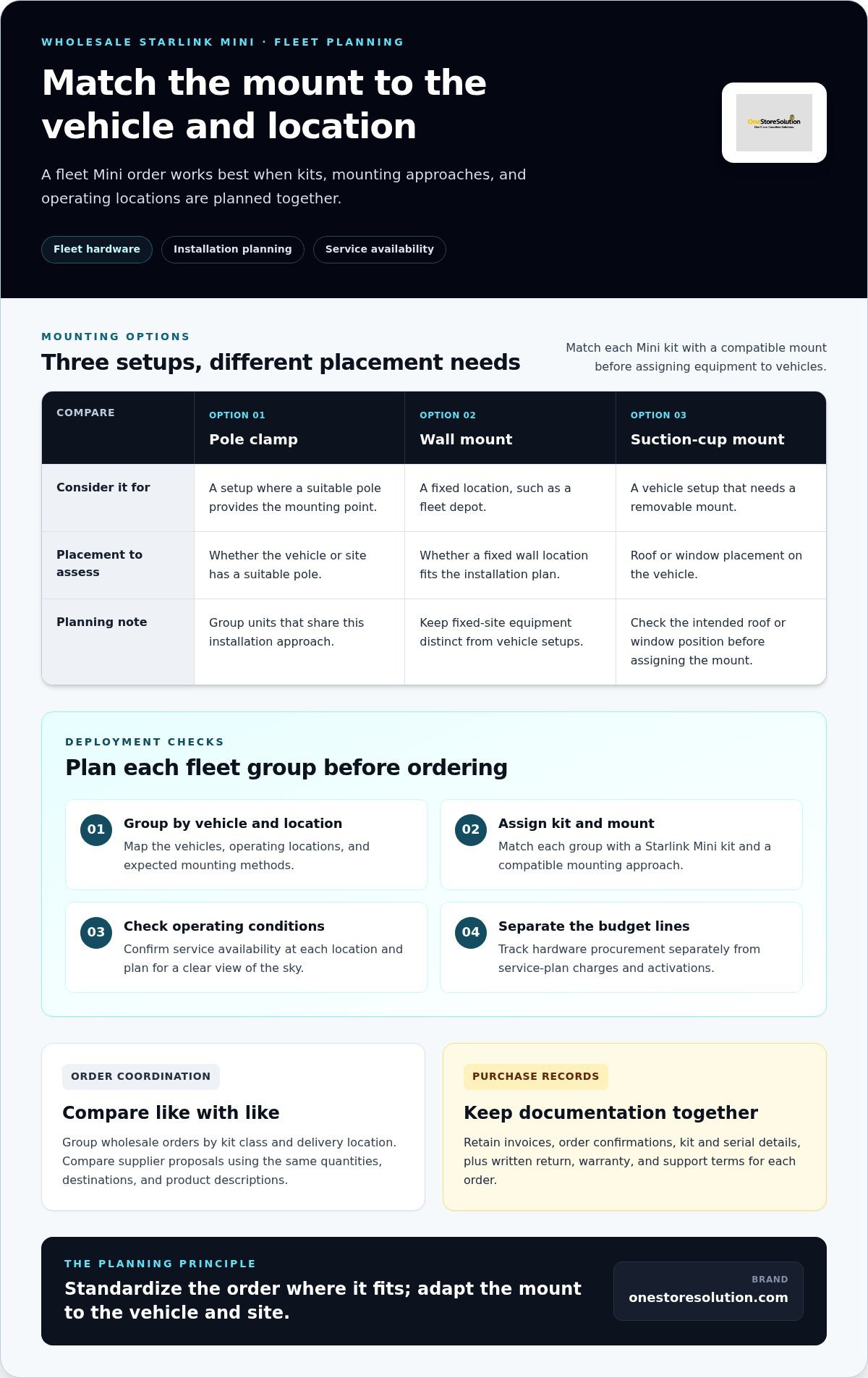
Fleet buyers can use Starlink Mini kits to equip vehicles that need mobile internet access. Bulk purchasing can standardize hardware across a fleet, while the installation plan accounts for different vehicle types. Before ordering, map the vehicles, operating locations, and expected mounting methods. Starlink availability depends on location, and each dish needs a clear view of the sky. Include both factors in deployment planning.
For U.S. buyers, Starlink kit prices depend on the selected kit and wholesale order terms. Business-plan charges are separate service costs, and availability depends on location. Treat hardware procurement and internet service as separate budget lines, then compare each kit class with its intended fleet use.
Mounting needs vary by vehicle. A pole clamp, wall mount, or suction-cup mount supports a different installation approach, while a vehicle’s roof or window affects placement. Wholesale assortments may include mounting kits and installation accessories. Match each Mini kit with a compatible mount before assigning equipment to vehicles, rather than treating the terminal and mounting setup as one standard package.
- Pole clamp: Consider this option where a suitable pole provides a mounting point.
- Wall mount: Use this configuration for fixed locations, such as a fleet depot.
- Suction-cup mount: Assess roof or window placement for vehicles requiring a removable setup.
Bulk purchases are subject to the seller’s written return and support terms, while hardware warranty coverage follows applicable manufacturer terms. Include those terms in resale documentation so business customers understand how defective equipment, returns, and support requests are handled. Keep purchase records and kit details together for each order.
For a fleet order, group vehicles by installation type and operating location. Assign a Starlink Mini kit and mounting approach to each group, then separate hardware quantities from service activations in the purchasing plan. This helps resellers compare like-for-like orders, prepare clearer customer quotes, and coordinate deployment without assuming every vehicle needs the same setup.
Why Stock Starlink Wholesale?
Wholesale sourcing lets resellers plan hardware orders around customer demand. Compare kit quantities, service needs, and delivery arrangements before committing. A Starlink satellite kit wholesale distributor can help businesses coordinate commercial hardware orders, while service activation remains a separate consideration.
Volume Pricing and Data Plans
U.S. Starlink kit pricing depends on the kit class, order volume, and seller terms. Data-plan charges are separate from hardware costs and depend on the selected service and location. Create separate budget lines for equipment and connectivity rather than treating them as one purchase.
Wholesale buying does not make every kit suitable for every customer. Match the hardware class to its intended use, then account for installation needs and service availability at the operating location. This gives buyers a clearer basis for comparing order proposals and separating recurring service costs from kit procurement.
Bulk Procurement and Logistics
Wholesale kits are available through distribution channels, but a distributor’s offer does not, by itself, mean Starlink sells directly to that distributor. A Starlink satellite kit wholesale distributor may source equipment for commercial resale, but that alone does not establish authorization from Starlink. Distinguish the seller’s role from any formal authorization.
Start logistics planning with the destination and product mix. Group orders by kit class and delivery location, then align the shipping schedule with resale or installation plans. Compare supplier proposals using the same quantities, destinations, and product descriptions to assess differences in order terms.
Seller Authorization and Purchase Risks
Assess a seller by checking that the business name on its quotation and invoice matches, and that product descriptions and written terms are consistent. Request documentation identifying the specific kit model and serial details. Before placing a bulk order, review the stated process for returns, warranty claims, and support. These records help link delivered units to their purchase documentation.
Purchasing through an unauthorized or poorly documented seller can create uncertainty about product origin, returns, warranty handling, and service activation. A low purchase price alone does not resolve those risks. Keep invoices, order confirmations, serial details, and support terms together for each shipment. Those records help resellers handle customer questions and trace issues to the relevant order.
Wholesale procurement process and lead times
Plan a wholesale order around the product mix, delivery destination, and resale schedule. Lead times depend on stock position, order preparation, and shipping arrangements.
Reseller and Distributor Authorization
Buying kits wholesale does not, by itself, establish authorization to resell as a Starlink representative. Starlink must explicitly grant authorization, so keep that status separate from a supplier’s ability to sell hardware. Businesses seeking authorized status should approach Starlink through its official business channels and follow the requirements provided there.
Before describing your business as an authorized reseller, retain written approval and confirm which activities it permits. Wholesale purchasing and authorization are separate decisions; an invoice for Starlink equipment alone does not establish a reseller relationship.
Authorized Distributor Sourcing
U.S. businesses seeking authorized supply should start with Starlink’s official business channels and identify the relevant distributor route. For a proposed supplier, request documentation establishing its relationship to Starlink. Before paying, check that the seller’s business identity, product description, and order paperwork align.
Keep authorization evidence with the quotation and invoice. These records help distinguish authorized supply from wholesale claims without documented status. They also give your purchasing team a consistent basis for reviewing suppliers and recording resale inventory.
For procurement, define the kit models and quantities you need, then provide the ship-to destination and preferred delivery window. Ask for an order confirmation that records product descriptions, quantities, shipping arrangements, and any terms affecting delivery. Mixed orders may require coordination across products, so confirm whether the shipment will arrive together or in separate consignments.
Lead times depend on stock availability, order processing, shipping distance, and the order’s product mix. For example, an order containing several kit classes may require different allocation or packing steps. Build these dependencies into the resale schedule rather than assuming every unit will arrive at once. Track the order from confirmation through dispatch, then reconcile delivered units against the purchase record.
Wholesale Starlink kit classes
Wholesale Starlink kits generally fall into three classes: standard, mobile, and business. Classifying inventory by use case helps resellers match stock to customer requirements. The main distinction is where customers expect to use the connection, not simply the kit’s size.
Standard kits suit home use, where equipment can remain in a fixed position. Mobile kits serve vans, RVs, and boats that need connectivity while traveling or at temporary sites. Business kits are intended for office use. For resale, these categories can guide an initial product mix: home-focused inventory, mobile equipment, and office-oriented kits.
For mobile use, placement is an important part of the decision. Starlink dishes need a clear view of the sky, so rooflines, trees, and nearby structures can affect installation. Mounting needs also vary between a van, RV, and boat. Treat the kit and mounting approach as related choices, and organize stock descriptions around the intended vehicle or site.
Location matters for every class. Starlink availability depends on the customer’s location, so customers should check coverage before activating service. A kit intended for a boat or traveling vehicle still needs suitable service availability at its operating location. Resellers can help customers distinguish hardware selection from service activation, rather than treating the kit alone as a complete connectivity plan.
Use a straightforward assortment process. Sort expected buyers into home, mobile, or office use, then match the kit class to the intended setting. Consider the installation environment and visibility of the sky as well. Most people can set up a Starlink kit themselves using the included stand and app guidance, but a fixed office installation may call for a different placement plan than temporary vehicle use.
For a focused commercial assortment, compare wholesale Starlink kit options with the customer groups you serve. Stocking around use cases gives buyers clearer choices across standard, mobile, and business connectivity needs.
One Store Solution: OCB ACCESORIES
One Store Solution supports commercial buyers and retailers with wholesale merchandise across several categories. Alongside separately planned Starlink inventory, businesses can source OCB Accessories, reusable gas lighters, wholesale groceries, and pet food and animal feed for a broader product mix.
This range is useful for purchasing teams managing multiple merchandise categories and considering complementary wholesale stock alongside their core inventory. Choose categories according to the customers you serve and the assortment your business is building.
For wholesale groceries, pet food, animal feed, or accessories, visit onestoresolution.com or contact One Store Solution.
Plan Your Next Wholesale Order
Turn your fleet requirements into a purchasing plan that fits your wider business priorities. If you’re selecting a Starlink satellite kit wholesale distributor, consider how connectivity inventory fits alongside the other products your business sells and sources. A coordinated approach helps purchasing teams make clear assortment decisions.
One Store Solution supplies OCB accessories, reusable gas lighters, and wholesale groceries to commercial buyers and retailers. These categories can help businesses build a broader wholesale assortment alongside their technology procurement.
Share your wholesale requirements and product interests with One Store Solution to explore a suitable next step. Contact One Store Solution about wholesale and continue building your purchasing plan with confidence.
Frequently Asked Questions
Are wholesale discounts or minimum order quantities available for Starlink hardware?
Discounts and minimum order quantities depend on the seller’s wholesale terms and the products in the order. There is no single standard threshold for every Starlink kit purchase. For planning, compare quotes using the same kit models and quantities, and review whether the stated minimum applies per model or across the full order.
What taxes, shipping costs, and import rules apply to Starlink bulk purchases in the US?
Tax treatment depends on the transaction and delivery destination; shipping charges depend on shipment size, route, and delivery terms. For cross-border orders, customs paperwork and import charges may apply, with responsibility shaped by the agreed shipping terms. Keep tax, freight, and any import-related charges as separate budget lines so the landed cost is clear before resale.
Can Starlink kits bought wholesale be activated on any US service plan?
Activation depends on service availability at the customer’s location, so check coverage before activating. Wholesale hardware does not determine the service plan.
